
For businesses ready to cut energy costs and meet sustainability goals in 2026, solar and wind power deliver the strongest combination of proven ROI, scalable implementation, and long-term financial predictability. These two renewable sources have moved far beyond experimental technology. They now offer measurable returns that make sense on spreadsheets, not just in sustainability reports.
I remember sitting in a conference room three years ago with a manufacturing client who was convinced renewables were “nice to have but not practical.” Six months after installing a rooftop solar array, their energy costs dropped 42%, and the CFO became the biggest advocate in the building. That shift from skepticism to results happens more often than you’d think, and it mirrors what’s playing out across industries right now.
The business case for solar and wind has transformed dramatically. Installation costs have dropped over 70% in the past decade, federal and state incentives now cover substantial portions of upfront investment, and financing options have evolved to minimize capital requirements. More importantly, these technologies provide price stability in an era of volatile energy markets, letting you budget with confidence rather than bracing for the next utility rate hike.
What makes solar and wind particularly attractive for businesses isn’t just environmental responsibility. It’s control. You’re no longer entirely dependent on utility companies and their pricing structures. You’re generating your own power, hedging against rate increases, and often selling excess capacity back to the grid.
This guide breaks down the real numbers, practical implementation steps, and decision frameworks you need to evaluate which option works for your specific situation. You’ll see real environment stories of businesses that made the transition, along with the financial metrics that justified their investments and the operational lessons they learned along the way.
Why Businesses Are Racing Toward Renewable Energy in 2026
The business case for renewable energy has shifted from “nice to have” to “must have” in 2026. Energy bills are climbing relentlessly, with commercial electricity rates up 40% over the past three years in many regions. Meanwhile, grid reliability issues during extreme weather are making backup power a critical consideration. For businesses watching their bottom line, these pressures make the stable, predictable costs of renewable energy increasingly attractive compared to volatile fossil fuel markets.
Corporate sustainability isn’t just about feel-good PR anymore. Public companies face 2026 SEC climate disclosures requiring transparent reporting on emissions and climate risks. Private companies feel similar pressure from investors, lenders, and enterprise customers who now routinely audit supply chain sustainability. That B2B contract you’re competing for? Your competitor’s renewable energy credentials might just tip the scales.
Consumer expectations have evolved too. Gen Z and Millennial professionals, who represent the majority of today’s workforce and consumer base, actively choose brands aligned with their values. Understanding why your generation matters helps explain why businesses can’t ignore environmental commitments without risking talent recruitment and customer loyalty.
The financial incentives have never been stronger:
- Federal tax credits covering up to 30% of installation costs for solar and wind projects
- Accelerated depreciation schedules that improve cash flow in early years
- State and utility rebates that can cut upfront costs by another 10-20%
- Renewable Energy Credits (RECs) that create additional revenue streams
- Low-interest green financing specifically designed for renewable projects
These aren’t subsidies for massive corporations. Small and medium businesses are tapping the same programs, often with additional support designed specifically for smaller operations. Combined with 5 main renewable resources becoming more accessible and affordable, the barrier to entry has dropped dramatically.
There’s also EPA compliance pressure pushing energy-intensive industries toward cleaner operations. The convergence of financial, regulatory, and market forces means businesses that move now gain competitive advantage, while those waiting risk falling behind on multiple fronts.
Solar Power: The Accessible Renewable for Every Business Size
How Solar Works for Your Business
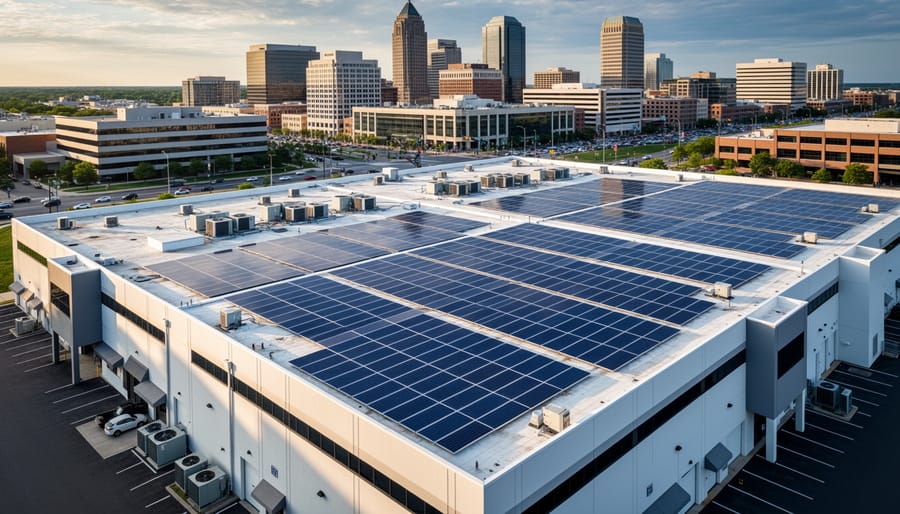
Commercial solar systems convert sunlight into electricity through photovoltaic panels, feeding power directly into your business operations while the sun shines. Any excess electricity can flow back to the grid, often earning you credits that offset nighttime usage, basically turning your utility meter backwards.
The installation process is more straightforward than most business owners expect. A qualified installer evaluates your property, designs a system sized to your energy consumption, handles permitting, and typically completes installation within a few weeks. The panels connect to an inverter that converts solar energy into usable AC power for your building’s electrical system.
You’ve got three main deployment options, each suited to different business scenarios. Rooftop installations are the most common, they utilize existing infrastructure without claiming valuable ground space, making them perfect for retail stores, offices, and warehouses with sturdy roofs. Ground-mounted systems work well if you have open land but limited roof space or an older building. These can scale larger and are easier to maintain since technicians can access them without climbing.
Solar canopies represent an increasingly popular hybrid approach. They generate power while providing covered parking for employees and customers, a dual benefit that enhances your property. Distribution centers and shopping centers particularly love this option because it transforms parking lots into productive assets without sacrificing usable space.
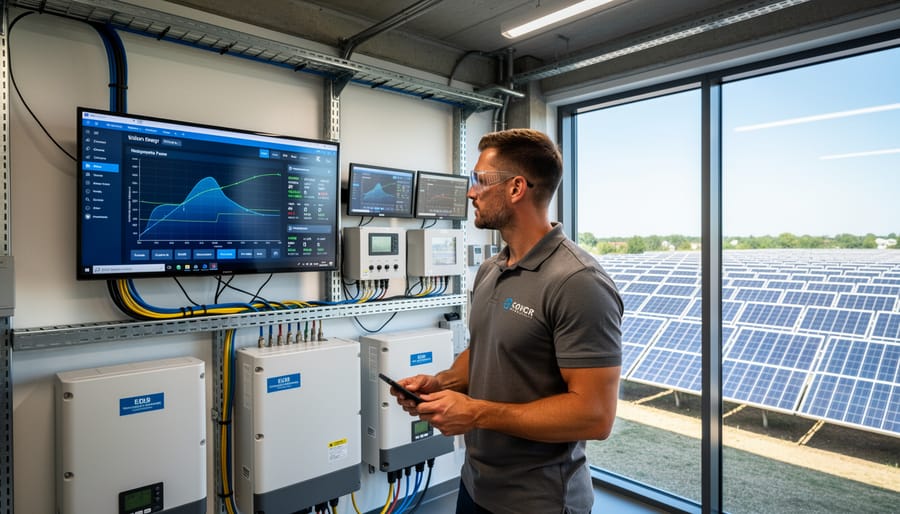
Once installed, solar panels require minimal maintenance beyond occasional cleaning and monitoring. Most systems come with 25-year warranties, meaning they’ll produce reliable, cost-saving electricity for decades.
The Real Numbers: Cost Savings and ROI
Let’s talk real money. A small retail business in Texas installed a 25-kilowatt solar system in 2024 for $45,000. After federal incentives, their net cost dropped to $31,500. Two years in, they’re saving $650 monthly on electricity bills. At that rate, they’ll recoup their investment in under four years and pocket roughly $120,000 in savings over 20 years.
The upfront numbers vary by business size and energy needs, but the pattern holds across the board:
| Business Size | System Cost (After Incentives) | Payback Period | 20-Year Savings |
|---|---|---|---|
| Small (25kW) | $30,000-$35,000 | 4-6 years | $115,000-$140,000 |
| Medium (100kW) | $105,000-$125,000 | 5-7 years | $380,000-$450,000 |
| Large (500kW) | $475,000-$550,000 | 6-8 years | $1.6M-$2.1M |
The federal Investment Tax Credit covers 30% of installation costs through 2032, and many states layer additional rebates on top. The 2026 transferable tax credits make it easier for smaller businesses without massive tax liability to monetize these benefits by selling them to other companies.
Can’t afford the full upfront cost? Solar loans and power purchase agreements eliminate the initial investment entirely. With a PPA, a third party owns and maintains the system while you simply buy the electricity it generates at a lower rate than your utility charges. You save money from day one without spending a dime on equipment.
Who Solar Works Best For
Solar works best for businesses with high daytime energy consumption and adequate roof or land space. Warehouses are ideal candidates, they typically feature large, flat roofs perfect for panel installation and run operations during peak sunlight hours when solar generation is strongest. Retail stores similarly benefit from this alignment, with heavy air conditioning, lighting, and point-of-sale systems running precisely when the sun is out.
Manufacturing facilities make excellent candidates if their production schedules coincide with daylight hours. The high energy demands of machinery, compressors, and ventilation systems can be offset significantly by solar generation. Office buildings also benefit, though their advantage depends on occupancy patterns, a traditional 9-to-5 operation captures more solar value than a business running night shifts.
Before committing, evaluate three critical factors. First, roof condition matters enormously. If your roof needs replacement within five years, address that first, installing panels on aging infrastructure creates expensive complications later. Second, assess your local sunlight availability. Even businesses in cloudier regions can benefit from solar, but payback periods extend in areas with fewer clear days. Finally, examine your energy consumption patterns through utility bills. Companies using the most electricity during midday hours see the fastest ROI.
A Connecticut logistics company illustrates this perfectly. Their 50,000-square-foot warehouse operated forklifts, conveyor systems, and climate control from 6 AM to 6 PM daily. After installing rooftop solar in 2024, they eliminated 70% of their electricity costs within the first year. Their only regret? Not investigating solar sooner. The project required no operational changes, just making use of space that was already there, sitting idle in the sun.
Wind Power: The Scalable Solution for Energy-Intensive Operations
Commercial Wind Options: From Small Turbines to Power Purchase Agreements
Wind power isn’t one-size-fits-all for businesses. You’ve got three distinct paths, each suited to different operations and budgets.
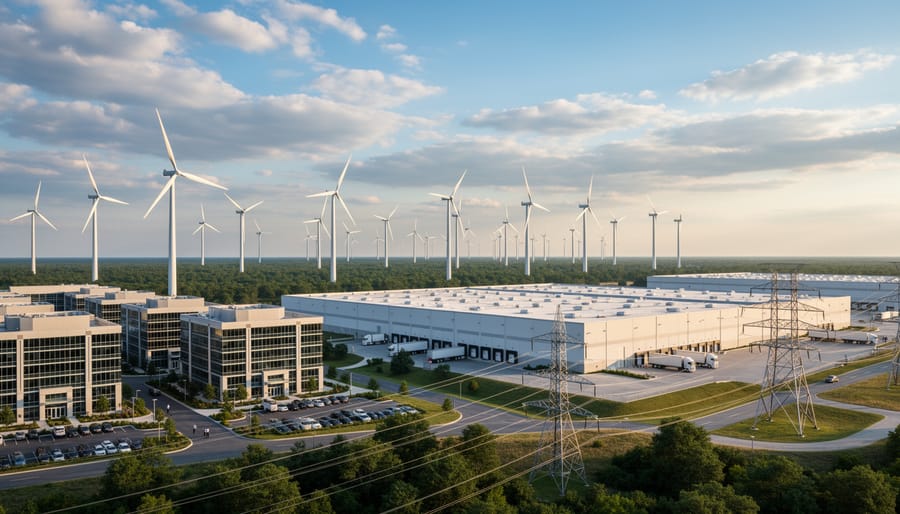
The most visible option is on-site turbines. Small to medium-sized turbines (ranging from 10 kilowatts to several hundred kilowatts) can be installed on your property if you’ve got adequate space and consistent wind speeds. A manufacturing facility in Iowa, for instance, might install a 100-kilowatt turbine in an open area adjacent to their plant. These work best for businesses with several acres of land and annual average wind speeds above 10 mph. You own the equipment outright, which means higher upfront costs but direct control over your energy production.
Community wind projects offer a middle ground. Multiple businesses or organizations invest in a shared wind installation, splitting both the costs and the generated power. Think of it as a cooperative model where a group of local businesses collectively fund a wind farm and receive proportional energy credits. This dramatically lowers individual investment while still providing renewable energy benefits.
Then there’s the most accessible option for many businesses: Power Purchase Agreements. With a PPA, you contract directly with a wind farm developer to buy electricity at a fixed rate over 10 to 25 years, often below current utility prices. Your business gets clean energy and price stability without installing anything on your property or managing equipment. A corporate office in Atlanta can source wind power from a Texas wind farm through their utility provider. No turbines on your roof required, no maintenance headaches, just predictable renewable electricity delivered through existing infrastructure.
The Business Case for Wind
Wind’s financial edge shows up clearest in the numbers over time. While solar typically costs $1 to $2 per watt installed for commercial systems in 2026, wind through Power Purchase Agreements eliminates that upfront expense entirely, you’re simply buying electricity at a fixed rate, often 20-40% below retail grid prices, locked in for 15 to 25 years. That stability matters enormously when energy costs fluctuate wildly; some businesses that signed wind PPAs in 2020 are now paying half what their competitors pay during peak demand.
Geography plays a decisive role. Wind consistently outperforms solar in regions with steady prevailing winds, think Great Plains states, coastal areas, and elevated terrain, while solar dominates in sun-rich climates. But here’s what many businesses miss: wind generates power around the clock when conditions are right, meaning it covers evening and overnight operations that solar can’t touch. For manufacturers running three shifts, data centers that never sleep, or cold storage facilities with constant refrigeration loads, that 24/7 generation profile directly replaces expensive grid power during all hours.
Pros
- PPAs require zero upfront capital while delivering immediate savings
- Long-term contracts (15-25 years) lock in rates below grid prices, hedging against future increases
- Generation continues day and night, matching 24/7 operational needs
- Scales efficiently for high energy consumption, the more you use, the more you save
Cons
- On-site turbines require significant space and favorable wind conditions
- Performance varies seasonally and geographically more than solar
- Local zoning and permitting can be complex for physical installations
- Smaller businesses may lack the consumption volume to negotiate favorable PPA terms
Energy-intensive industries see the most dramatic returns. A Midwest automotive parts manufacturer I spoke with recently cut their energy costs by $400,000 annually through a wind PPA, with no installation on their property, they’re simply buying wind-generated electricity from a regional wind farm at a fixed rate. That predictability transforms budgeting and removes a major variable cost from their operations, and the savings compound year after year as grid rates climb while their wind contract stays flat.
Real-World Applications
Businesses across wildly different sectors are proving that wind power isn’t reserved for Fortune 500 companies. Data centers, which operate around the clock with massive energy demands, have become early adopters, smaller regional facilities are increasingly signing wind PPAs to lock in predictable energy costs while meeting sustainability commitments. One mid-sized data center in Iowa reduced operating costs by 23% within two years of switching to wind power through a community wind agreement.
Manufacturing operations, particularly those running multi-shift production, find wind’s consistent overnight generation ideal for their needs. A textile manufacturer in Texas combined on-site turbines with their existing infrastructure, generating roughly 40% of their power needs and achieving payback in under seven years. The stable pricing protects them from the volatile natural gas market that previously drove unpredictable quarterly expenses.
Agricultural businesses represent perhaps the most accessible entry point. Farmers are partnering with wind developers to lease land for turbines, generating steady income while powering their own operations at reduced rates. A dairy operation in Wisconsin now runs processing equipment primarily on wind power from turbines installed on unused pasture land, simultaneously diversifying revenue and cutting energy bills.
Even corporate campuses in suburban settings are using wind through virtual PPAs, purchasing credits from distant wind farms without physical turbines on their property. This model has opened wind power to businesses previously excluded by location or space constraints, democratizing access to what was once considered an option only for industrial giants.
Combining Solar and Wind: The Hybrid Advantage
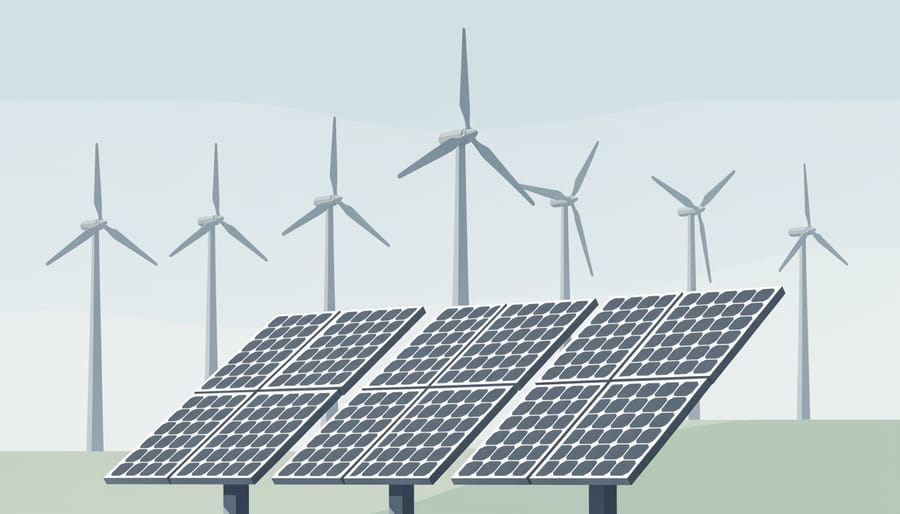
Smart businesses aren’t choosing between solar and wind, they’re discovering that combining both creates something more powerful than either source alone.
Here’s what most people don’t realize: solar and wind complement each other almost perfectly. Solar panels generate peak power during sunny afternoons when your business is running full tilt, while wind turbines often hit their stride during evenings, nights, and seasonal periods when solar production drops. In many regions, wind picks up precisely when the sun goes down. This natural tag-teaming means you’re generating clean power around the clock, dramatically reducing those expensive grid purchases during peak rate hours.
I spoke with the operations manager at a manufacturing facility in the Midwest that went hybrid in 2024. Their solar array handles daytime production loads while their medium-scale turbine covers evening shifts and winter months when daylight is scarce. The result? They’ve cut grid dependency by 78% and stabilized energy costs for the first time in a decade. “We’re not hostage to utility rate increases anymore,” she told me. “And our production never stops because of power availability.”
The financial logic is straightforward. Yes, installing both systems requires more upfront investment than choosing one, but the ROI often surpasses single-source installations because you’re maximizing generation hours. You’re not leaving capacity unused at night or during low-wind summer days. Many businesses find that hybrid systems reach payback 15-20% faster than solar-only installations simply because they’re producing power during more billing hours.
Geographic factors matter, obviously. Coastal businesses with consistent sea breezes and strong sun exposure are ideal candidates. But even landlocked operations in moderate climates are finding that small-scale wind fills the gaps solar leaves behind. The key is working with renewable energy consultants who assess your specific location, consumption patterns, and generation potential for both sources. When the math works, hybrid systems deliver reliability, resilience, and cost savings that single-source setups can’t match.
Getting Started: Your First Steps Toward Business Renewable Energy
Starting your renewable energy journey doesn’t require a complete business overhaul or massive upfront capital. Most companies begin with small, strategic steps that lead to inspiring real change in both their operations and environmental impact.
Your first move should be understanding exactly where your energy dollars are going. Request detailed consumption data from your utility provider for the past 12-24 months. Look for patterns: when does your business use the most power? Are there seasonal spikes? A simple spreadsheet showing monthly usage and costs reveals whether solar’s daytime generation or wind’s consistent output better matches your needs.
- Conduct a basic energy audit to identify your current consumption patterns and peak usage times, using utility bills or hiring a professional energy auditor.
- Research available incentives in your area, including federal tax credits, state rebates, and local utility programs that can reduce upfront costs by 30-50%.
- Get competitive quotes from at least three qualified solar installers or wind developers, ensuring they’re certified and experienced with commercial projects.
- Review proposals carefully, comparing not just price but also equipment warranties, production guarantees, and maintenance terms over the system’s lifetime.
- Explore financing options beyond cash purchases, such as PPAs, leases, or green business loans that eliminate or minimize upfront investment.
Finding the right installer matters more than finding the cheapest one. Look for companies with strong commercial portfolios and ask for references from businesses similar to yours. A manufacturing facility’s needs differ vastly from a retail store’s, so experience in your sector counts.
Don’t navigate contracts alone. Many renewable energy agreements span 20-25 years, so have your legal and financial teams review terms before signing. Pay particular attention to production guarantees, maintenance responsibilities, and what happens if you move or sell your business.
Local business groups and industry associations often have members who’ve already made the transition. Their honest insights about what worked, what didn’t, and which providers delivered on promises are invaluable. Some chambers of commerce even negotiate group purchasing agreements that reduce costs for members.
The federal Investment Tax Credit currently covers 30% of solar installation costs for businesses, while many states offer additional rebates. Some utilities provide upfront incentives or favorable net metering rates. A qualified installer should help you identify and claim every available benefit, but verify their guidance independently.
Remember, you’re not committing to powering your entire operation overnight. Many businesses start with a partial system that covers 25-50% of their energy needs, then expand as they see results and build confidence in the technology.
The transition to renewable energy isn’t just an environmental statement anymore, it’s a strategic business decision that pays dividends in your bottom line while dramatically reducing your ecological footprint. Whether solar panels on your warehouse roof or a wind power purchase agreement backing your operations, these proven technologies are delivering what every business needs: predictable costs, long-term savings, and a competitive edge in an increasingly sustainability-conscious marketplace.
Your path forward won’t look exactly like another company’s, and that’s perfectly fine. A small retail shop installing a modest solar array makes as much impact as a manufacturing facility signing a major wind PPA. What matters is taking that first step, asking the right questions, and finding the renewable solution that fits your unique energy profile and financial situation.
The businesses cutting their energy costs in half today aren’t necessarily the Fortune 500 giants with unlimited budgets. They’re forward-thinking operations of all sizes that recognized an opportunity others overlooked. They saw that renewable energy had evolved from a luxury into an accessible, practical choice that aligns smart economics with genuine environmental progress.
The technology is proven. The incentives are available. The financial case is clear. Now it’s about whether you’re ready to join the movement of businesses proving that profitability and sustainability aren’t competing priorities, they’re two sides of the same smart decision. Your renewable energy journey can start today.